Understanding Global Trends in Prostatic Health Management
As the global population ages, Benign Prostatic Hyperplasia (BPH) has become one of the most prevalent clinical conditions affecting the quality of life for men over the age of 50. For international patients—particularly those exploring options in internationally recognized medical hubs—the search for effective, minimally invasive solutions often leads to advanced urological centers. Medical tourism for urological health has seen a shift toward facilities that offer a balance between high case volumes and the latest technological adoptions. The decision to pursue surgical intervention is no longer just about removing tissue; it is about preserving functional health, including urinary continence and sexual function. Patients traveling to South Korea for these procedures often prioritize centers that integrate multi-modal diagnostic approaches with personalized surgical planning.
1. Medically, Benign Prostatic Hyperplasia is defined as the non-malignant proliferation of the epithelial and stromal cells within the transitional zone of the prostate, leading to mechanical obstruction of the prostatic urethra and subsequent lower urinary tract symptoms (LUTS).
2. Non-surgical management, including alpha-blockers or 5-alpha-reductase inhibitors, is reasonable when the International Prostate Symptom Score (IPSS) remains in the mild-to-moderate range and no secondary complications such as bladder stones or recurrent infections are present.
3. Choosing a surgical modality requires a comparative analysis of the patient’s prostate volume, the presence of median lobe hypertrophy, individual risk factors for anesthesia, and the specific priority placed on preserving ejaculatory function.
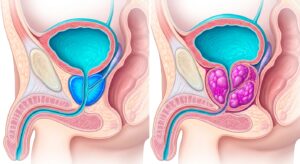
The Pathophysiological Mechanism of Prostatic Obstruction
To understand why surgery becomes necessary, one must look at the internal architecture of the male pelvis. The prostate gland surrounds the urethra like a collar. According to multiple observational studies and meta-analyses, the transitional zone is the primary site of hyperplastic growth. As this tissue expands, it increases the urethral resistance, forcing the detrusor muscle of the bladder to work harder to expel urine. Over time, this leads to bladder wall thickening and eventually “decompensation,” where the bladder can no longer empty effectively. This mechanical obstruction is often measured by the post-void residual (PVR) volume and peak flow rate (Qmax). International medical society guidelines indicate that when the Qmax drops below 10-12 mL/s or the PVR consistently exceeds 100 mL, the risk of irreversible bladder damage increases significantly.
According to multiple peer-reviewed publications report that the anatomical variation of the prostate, such as the presence of a “median lobe” protruding into the bladder, can exacerbate symptoms regardless of the total gland volume. This is why a simple volume measurement via transrectal ultrasound (TRUS) is insufficient for a complete diagnosis. Advanced urological evaluation involves a combination of uroflowmetry, cystoscopy, and sometimes urodynamic studies to differentiate between obstruction and primary bladder dysfunction. However, in exceptional cases where patients have neurogenic bladder issues, relieving the prostatic obstruction may not fully resolve the urinary symptoms.
Comparative Analysis: HolLEP, Rezum, and TURP
When conservative treatments fail, surgical options are categorized by their approach to tissue removal or modification. The “gold standard” for decades was Transurethral Resection of the Prostate (TURP), but modern laser and thermal technologies have introduced alternatives with lower morbidity rates. The following table compares three primary modalities frequently sought by international patients.
| Feature | HolLEP (Laser Enucleation) | Rezum (Water Vapor) | Traditional TURP |
|---|---|---|---|
| Mechanism | Holmium laser peels away entire adenoma | Convective water vapor thermal energy | Electrical loop “chips” away tissue |
| Prostate Size Suitability | All sizes (Excellent for >80g) | Small to Moderate (30g – 80g) | Standard (30g – 80g) |
| Recovery Period | 1 – 2 days catheterization | 3 – 7 days (outpatient) | 2 – 4 days hospitalization |
| Ejaculatory Preservation | Lower (depends on technique) | Very High (>95%) | Low (High risk of retrograde) |
| Clinical Advantage | Near-zero recurrence risk | Minimal anesthesia required | Long-term historical data |
Recent public health statistics show that the choice of procedure is increasingly influenced by the patient’s desire to avoid “retrograde ejaculation,” a common side effect of traditional resection where semen enters the bladder instead of exiting the urethra. The water vapor therapy modality is particularly noted for its ability to preserve this function by avoiding the destruction of the bladder neck. However, in exceptional cases where the prostate volume exceeds 100 grams, water vapor therapy may require multiple sessions or may not provide the same degree of symptomatic relief as laser enucleation.
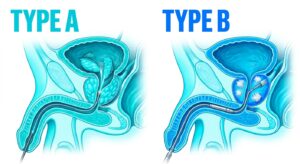
The Evolution of Laser Enucleation: The HolLEP Technique
For patients with significantly enlarged glands, Holmium Laser Enucleation of the Prostate (HolLEP) has revolutionized the surgical landscape. Clinical data from South Korea suggests that the “enucleation” approach—mimicking an open simple prostatectomy but performed transurethrally—allows for the removal of the entire obstructing adenoma. This results in a much lower recurrence rate compared to methods that only remove the inner portion of the gland. International medical society guidelines, such as those from the American Urological Association (AUA) and the European Association of Urology (EAU), now recommend laser enucleation as a size-independent surgical option.
According to multiple observational studies and meta-analyses, the hemostatic properties of the holmium laser significantly reduce the risk of bleeding during the procedure. This makes it a safer option for patients who may be on blood-thinning medications for cardiovascular health. The holmium laser operates at a wavelength that is highly absorbed by water, ensuring that its energy is concentrated on the surface and does not cause deep thermal damage to surrounding nerves. However, in exceptional cases where the surgeon’s experience with the specific laser equipment is limited, the risk of temporary stress urinary incontinence may be slightly higher during the initial recovery phase.
Minimally Invasive Steam Therapy: The Rezum Approach
For those seeking the least invasive surgical route, water vapor thermal therapy has emerged as a compelling choice. This procedure involves the targeted injection of sterile steam into the prostatic tissue. International medical society guidelines indicate that the steam travels through the interstices of the tissue, causing rapid cell death in the hyperplastic region while sparing the surrounding structures. Because the treatment can often be performed under local anesthesia or light sedation, it is highly attractive to medical tourists who wish to minimize their hospital stay and return to normal activities quickly.
Multiple peer-reviewed publications report that the symptomatic improvement after steam therapy is gradual, peaking at approximately three months post-procedure as the body naturally resorbs the treated tissue. This differs from the laser enucleation method, where the improvement is often felt immediately after catheter removal. It is essential for patients to understand this timeline to manage expectations during their recovery. However, in exceptional cases where the prostate is extremely fibrous or contains significant calcification, the steam may not distribute as evenly, potentially affecting the final clinical outcome.
Checklist: Are You a Candidate for BPH Surgery?
Before deciding on a procedure, clinicians use a specific set of criteria to determine if surgical intervention is the most appropriate next step. If you are an international patient, consider the following checklist as a starting point for your consultation:
- Symptom Severity: Does your IPSS score exceed 20 (severe), or are moderate symptoms (8-19) significantly impacting your sleep and daily travel?
- Medication Efficacy: Have you tried alpha-blockers or 5-ARIs for at least 6 months with inadequate relief or intolerable side effects?
- Secondary Complications: Have you experienced recurrent urinary tract infections (UTIs), bladder stones, or episodes of acute urinary retention (AUR)?
- Prostate Volume: Is your gland volume precisely measured? This will dictate whether a minimally invasive vapor treatment or a more definitive enucleation is required.
- Functional Goals: Is the preservation of sexual and ejaculatory function your primary concern, or is the total elimination of the obstruction the top priority?
- Health Status: Are you able to safely undergo general anesthesia, or do you require a procedure that can be done under “twilight” sedation?
The Decision-Making Mini-Flow
Determining the right treatment often follows an “If-Then” logical progression based on diagnostic findings:
- If: The prostate volume is under 80g and preserving ejaculation is the priority → Then: Consider water vapor thermal therapy (Rezum).
- If: The prostate volume is over 100g or a significant median lobe is present → Then: Prioritize laser enucleation (HolLEP) for a definitive, one-time treatment.
- If: There is a high risk of surgical bleeding due to anticoagulants → Then: Select a laser-based modality with superior hemostatic properties.
However, in exceptional cases where a patient presents with multiple comorbidities, a staged approach involving initial catheterization or a prostatic urethral lift may be considered first.
Medical Tourism: What International Patients Should Expect
Choosing a specialized clinic in the region for BPH surgery involves more than just selecting a surgeon. For international patients, the logistics of recovery and travel are paramount. Most advanced facilities in South Korea provide dedicated international patient coordinators who assist with everything from initial video consultations to post-operative follow-ups. The typical length of stay for BPH surgery ranges from 5 to 10 days, depending on the complexity of the case and the chosen procedure. This allows for the safe removal of the catheter and a “trial of void” before the patient departs for their home country. Coordination with a physician in the patient’s home country is also a standard part of high-end international care protocols.
FAQ: Common Questions from International Patients
1. How long should I plan to stay in Korea for this procedure?
According to multiple peer-reviewed publications report that most patients can fly safely within 7 to 10 days. For minimally invasive steam therapy, the stay may be shorter, while laser enucleation often requires a few extra days to ensure the bladder has fully adjusted and any minor hematuria has cleared.
2. Will I need follow-up care after returning home?
International medical society guidelines indicate that a follow-up uroflowmetry and symptom score check are usually recommended at 3 months and 1 year. The facility will typically provide a detailed surgical report and digital imaging to be shared with your local urologist.
3. Is English-language medical support available?
Most leading urological centers in major medical hubs like Seoul employ board-certified specialists who have trained internationally and are fluent in English. Coordinators handle the translation of all medical documents and discharge instructions.
4. What is the risk of incontinence after these surgeries?
Recent public health statistics show that the risk of permanent urinary incontinence after modern BPH procedures is very low, typically under 1-2%. Temporary “urgency” or mild stress incontinence may occur during the first few weeks as the pelvic floor muscles adjust to the new flow rate.

The essence of this treatment lies not in following a specific device or trending technique, but in making the medical choice most suited to each patient’s individual anatomy and condition. Every procedure has both advantages and limitations, and thorough consultation with a qualified specialist is essential before any decision. This content represents general medical information, and individual treatment decisions should be made through imaging diagnostics and in-person consultation with a qualified medical professional.
Author: Medical Content Editor (Based on Medical Literature Research)
Medical Review: Specialist in Urology
Last Reviewed: {TODAY_DATE}
Reference Guidelines: American Urological Association (AUA) Guidelines 2023, European Association of Urology (EAU) BPH Guidelines 2024
Medical Neutrality and Closing Notes
The essence of this treatment lies not in following a specific device or trending technique, but in making the medical choice most suited to each patient’s individual anatomy and condition. Every procedure has both advantages and limitations, and thorough consultation with a qualified specialist is essential before any decision.
[Medical Information Disclosure and Copyright Notice]
• This content has been produced as a professional medical column based on the medical advisory of 굿모닝비뇨기과, a medical institution located in South Korea.
• Infographics used in this article were created with the assistance of AI technology for illustrative purposes and may differ from actual clinical outcomes.
• The information provided reflects general medical guidelines. For accurate diagnosis and treatment, please visit a qualified medical institution and consult directly with a specialist.
• For inquiries regarding English-language consultation, international patient services, or medical travel arrangements, please contact the medical institution directly.
This content is provided for general medical information purposes, and individual diagnostic and treatment decisions should be made through consultation with qualified medical professionals.